Canines at ‘Souls have a strong basis on real life canines. The added human-level intelligence and ability to shift does shake things up a bit, but ‘Souls wolves are still wolves and many instinctual aspects will remain the same.
If you are new to roleplaying wolves, you will definitely want to familiarize yourself with the species. Wikipedia and WolfCountry.net both offer a good summary of wolf basics. Pay attention to pack dynamics, diet, dens, and puppies. Don’t forget, you can always watch wolf videos to get some visuals.
Dominant & Submissive Behavior
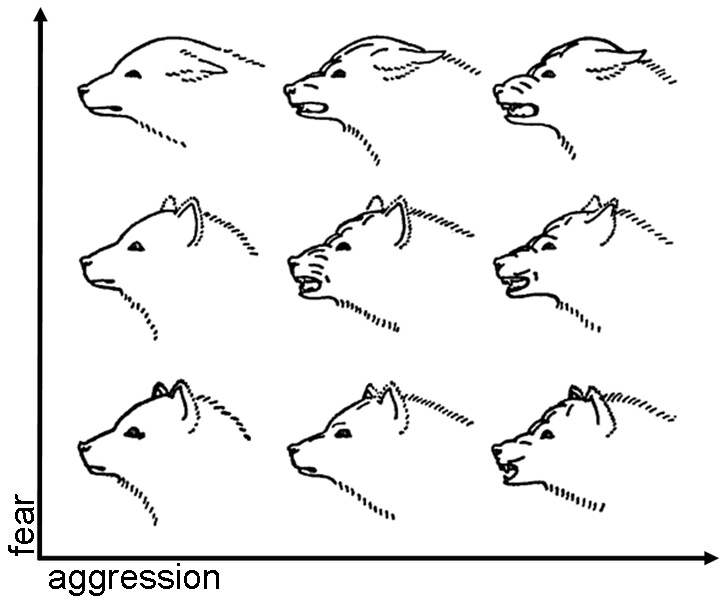
- Dominant wolves keep their heads and tails high and their ears erect. They will look directly at other wolves and can intimidate via eye contact.
- Submissive wolves will hold themselves in pretty much the opposite way — they keep their heads and tails low and their ears pinned backwards. Eyes will usually be averted from the dominant wolf, often looking towards the ground instead.
- Relaxed wolves will be somewhere in the middle, with head and tails at a casual, medium height, and ears pointed forward.
Wikipedia has a fairly comprehensive section on body language you should try to familiarize yourself with. The ‘Souls Wiki also provides a Member Guide for Wolf Behavior. Wolf videos are another good way to learn.
Dominant and submissive behavior is instinctive, but as more and more wolves at ‘Souls choose to adapt to a more human lifestyle, such formalities may be lessened. Leaders may not require that their subordinates act particularly submissive, preferring they all act like equals. Nevertheless, one should keep in mind that no matter how humanized a wolf becomes, he will still retain the instincts that have been present for thousands of years, and will react accordingly. A surprised and scared wolf will likely act submissive no matter how equal he acts in everyday life. 
Behavior in Different Areas
Wolves on their pack territories act differently depending on their rank. An omega may be required to be submissive, and an alpha may always maintain an appearance of dominance. Canines should submit and show respect to anyone ranked above them. Most times, a lowering of the head and a less-than-free tail will suffice, but certain higher-ranked wolves may request more of your character. This will, of course, also vary by pack as well as individual — some packs require strict adherence to hierarchy-appropriate behavior.
Many humanized aspects of ‘Souls wolves affect dominance and submission; different characters will have different preferences. Still — if your character is meeting a higher ranked wolf for the first time though, it is safest to be over-submissive than under-submissive.
Joiners
Unranked wolves seeking to join a pack — or “joiners” — must be especially careful when attempting to join a pack. Politeness is key, and canines don’t adhere to the same rules of ettiquete as humans do. For more information, see the Joining page.
As a Visitor
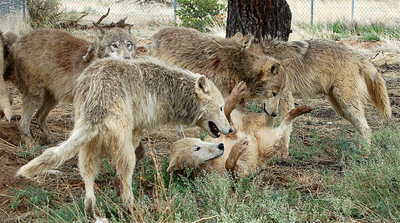
When visiting on foreign lands as a ranked wolf of a different pack, respect is key. You may not be required to show the same amount of extreme submission as an unranked wolf, but regardless of your home rank, you are a guest on foreign soil. Trespassing is considered very rude regardless of whether your character is a joiner or a wolf from another pack and should generally be avoided. Specific rules regarding trespassing can be found in section 5 of our Procedures.
Neutral Territory
For unclaimed territories, basically anything goes — unless you encounter a wolf of the same pack, in which case, the same behavior used on the packlands applies.
Hunting
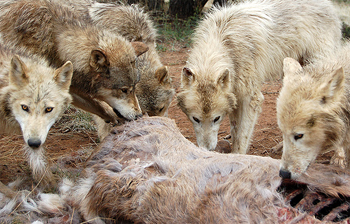
Naturally, wolves hunt to eat. Wolves will typically eat any kind of prey in the area, ranging from buffalo and caribou to rats and mice. Larger prey is generally only hunted in groups. Small prey can be taken down by an individual. Group hunts are a very special occasion for a wolf pack, usually called together by either one of the leader ranks or the pack’s designated hunter. Once the hunting party is gathered, they track animals and isolate a good candidate for hunting.
Once this candidate — usually sick, injured, very old, very young or otherwise vulnerable — is selected, the hunting party formulates a plan according to their position, the terrain, and the position of their prey. They then act on their plan, and once the animal is surrounded or cornered, take turns slashing and trying to find a good hold on the prey. Wolves’ jaws are capable of crushing necks, and throats are also a favorite place to hold. National Geographic has a clip about wolf hunting tactics and the ways they will take down prey.
Sounds
- Howl: Wolves howl to communicate across distances. A howl can be used to call a hunt, give news, mourn, express joy, or even mark territory. Generally, only simple messages are carried in a howl, though more complex messages are possible.
- Growl: A growl is usually a noise of dominance, aggression, or annoyance. However, a “happy” growl can express a desire to play and be something akin to a purr.
- Whimper: A whimper is a submissive or placid noise. Wolves also whine and whimper to express joy.
- Yelp: A yelp is a sound of pain or play.
- Bark: Wolves very, very rarely bark. When they do, it is usually for one of two reasons: alarm or play. A wolf will make a soft “woof” sound when they are alone and alarmed. A wolf will make a loud barking sound when they are in a group and notices danger. Wolves also bark to let the rest of the pack know they wish to play. When wolves bark, they typically do not bark in the repetitive manner of dogs — puppies are more prone to this behavior than adult wolves.
Though wolves are the dominant species at ‘Souls, coyotes, dogs, and hybrids are not uncommon. Other species may have variations of the above sounds or express themselves with sounds unique to them. For example, a coyote’s howl is generally higher-pitched and more “whiny” than a wolf’s, and the basenji — a breed of dog — has a trademark yodel. See the Species Guide for more information.