Flora
|
Areas Page Editors: please follow the Guidelines, whether you are editing an in-game area or World Territory. |
|
Return to: Flora - Plant Guide - Flora category |
Introduction
On this page... (hide)
- 1. Editing Pages
- 2. Ecozone: Atlantic Maritime
- 3. Forest Plants
- 3.1 Tree Layer
- 3.2 Shrub Layer
- 3.3 Herbaceous Layer
- 3.4 Forest Floor
- 4. Wetland and Aquatic Plants
- 5. Non-Native Plants
- 6. Resources
This Flora guide is intended to provide a comprehensive (but not complete) list of potential plants found within 'Souls playable territories, including important information about the area's biome and ecoregions.
For information about cultivation, harvesting, and the uses of specific plants (such as medicinal, edible, aromatic, etc.) please visit the accompanying Plant Guide.
1. Editing Pages
- Absolutely feel free to edit pages of a particular plant being used.
- You can copy/paste from Creative Commons sources such as Wikipedia, but other sources should be quoted and cited.
- Do not include information extraneous to 'Souls: for example, if Yarrow is used in antibiotics, but production of said antibiotic requires a laboratory process to create, information regarding that antibiotic doesn't belong on our Wiki.
- Double check a plant's toxicity to canines, horses, livestock, etc. Wikipedia alone often does not list this information so you'll have to seek it out on another website, e.g.: Dog Health, ASPCA, Pet Poison Helpline, Plants Poisonous to Livestock.
1.1 Creating New Pages
- Please only make pages for plants with some kind of use or appearance in the game. We don't want this to be an archive of every possible plant ever -- a list of many native plants, plus particularly useful non-native plants capable of growing in our biome is the aim here.
- If you come across a plant without a page that you feel would be useful enough to have one, please feel free to create one for it! We love you for that! :)
2. Ecozone: Atlantic Maritime
The Atlantic Maritime ecozone consists of two major regions: the Appalachians which are hilly with poor soils, and the coastal plains which have much richer soil. The inland regions are primarily highlands of igneous bedrock with acidic soils that support expansive forests, but are not adaptable to agricultural uses. The coastal plains are atop sedimentary bedrock, with rich soils suitable for agricultural applications. Within this all-encompassing ecozone, 'Souls is home to three specific ecoregions that expand further on the specific geographical characteristics, habitats, and wildlife likely to be found in a particular area of the territory.
2.1 Acadian Forests
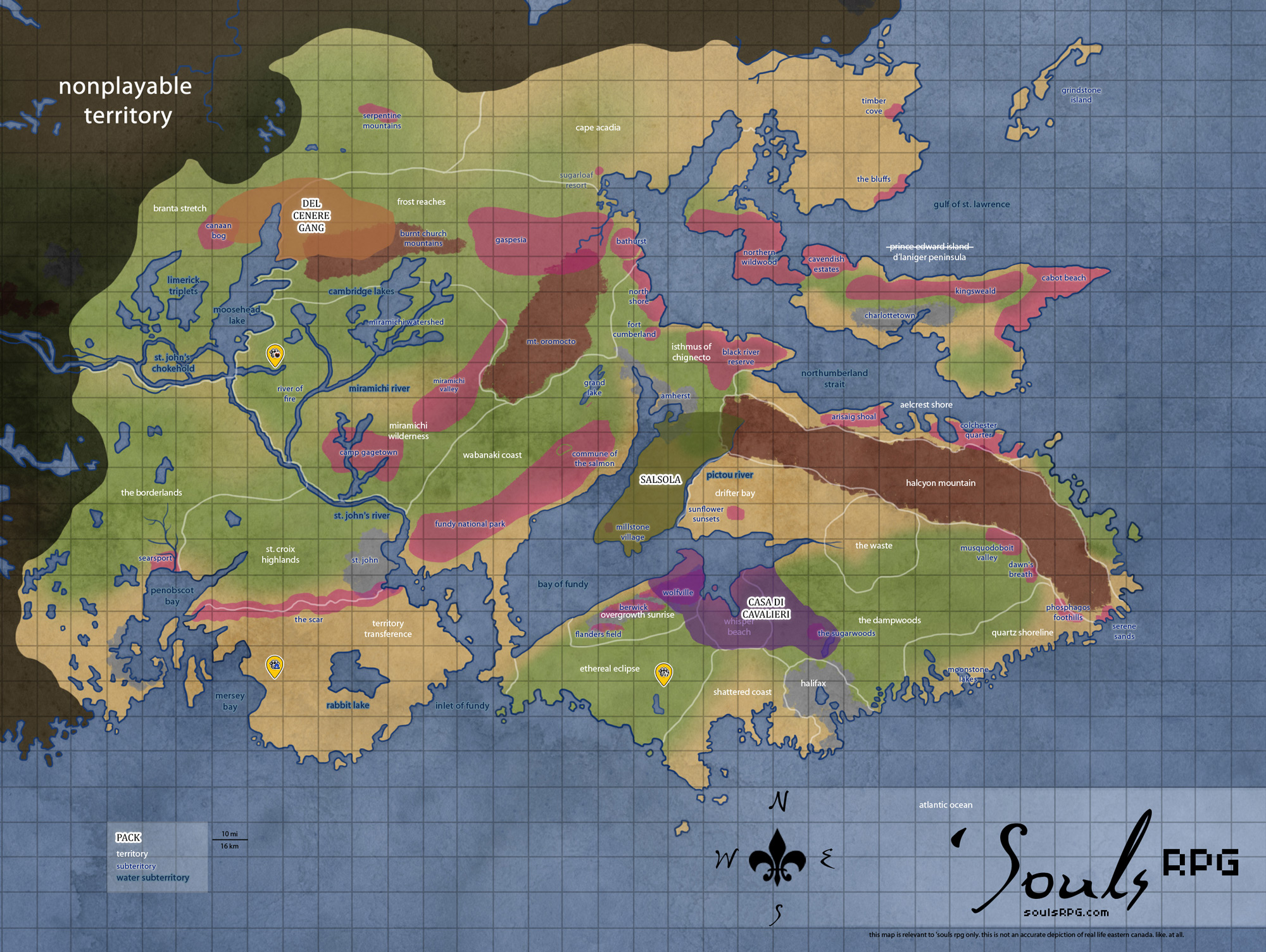
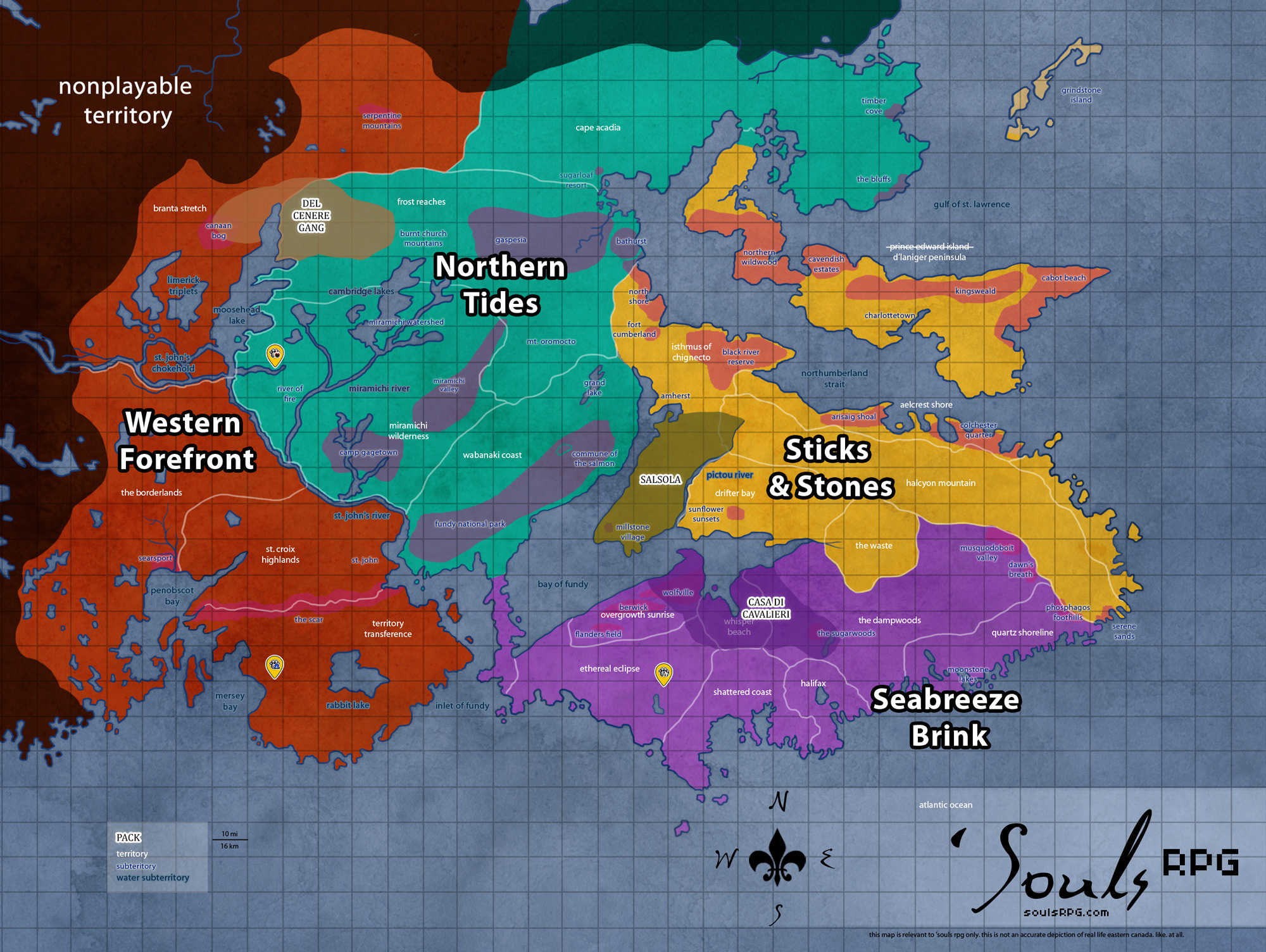
Excluding where noted in the other two ecoregions below, our playable territories is dominated by New England-Acadian forests. This includes the entirety of the Western Forefront, the Wabanaki Coast of the Northern Tides region, and the vast majority of both the Sticks and Stones and Seabreeze Brink regions. There is prevalence in the canopy of Red Pine, Paper Birch, Jack Pine, and Red and White Spruce.
2.2 St. Lawrence Lowland Forest
This ecoregion covers all of D'Laniger Peninsula, the easternmost half of Cape Acadia, and most of east-central Northern Tides (likely dominating the Miramichi Wilderness). Stretches of this ecoregion can also be found along the Northumberland Strait coastline of the Sticks and Stones region and the eastern shore of Loch Fundy, extending from the south-eastern edge of The Waste and ending near Clements Park. Trees of this ecoregion include Eastern Hemlock, Balsam Fir, American Elm, Black Ash, White Pine, Red Maple, Red Oak, and all three types of Spruce.
2.3 Eastern Canadian Forests
The smallest ecoregion found in 'Souls, the Eastern Canadian Forest is confined to just a circular area in the Frost Reaches as well as the westernmost half of Cape Acadia, both located in the Northern Tides region. These forests are known best for their prevalence of coniferous trees, including Balsam Fir, Black Spruce, and White Spruce and coastal heath shrubs, such as Rhododendron, Cranberry, and Blueberry.
3. Forest Plants
This section focuses on the community of plants that form forests. It is broken down into subsections based on stratification, starting with the tree layer and ending with the forest floor. Because of its expansive land area and differences in climate, it is important to note that not all of these trees or herbaceous plants will be found sharing the same community everywhere. Many of these trees, shrubs, and herbaceous plants can also be found along riparian zones or in floodplains, but not exclusively.
3.1 Tree Layer
With their thick, woody stems and prodigious size, trees make up the canopy of the forest and determine the growing conditions for every other plant underneath it. Trees are categorized in a number of various ways, but the species found within our playable territories are best divided into two groups: conifers (cone-producing "softwoods" with needle-like leaves) and broadleaves (flowering "hardwoods" with flat leaves). All of the forests found in 'Souls are broadleaf and mixed forests, meaning that both conifers and broadleaves are present.
- American Beech: This tree found throughout 'Souls. It is deciduous, growing to 20–35 m (66–115 ft) tall. It has smooth gray bark, dark green leaves, and extremely hard, heavy wood. Lacking the chainsaw, early humans generally left beech trees to grow.
- American Elm: This deciduous tree is found throughout 'Souls. It is a medium sized tree, growing 30 m (100 ft) tall. The crown forms a high, spreading canopy with open air space beneath.
- American Linden: This large (60 to 120 ft) deciduous tree is found in the southerly reaches of the Northern Tides territory, particularly the Saint Croix Highlands and southern Wabanaki Coast. The wood is pale brown, sometimes nearly white or faintly tinged with red; light, soft with fine close grain; clear of knots but does not split easily. It was valuable in the manufacture of wooden-ware, cheap furniture, bodies of carriages, and wood-carving. The inner bark is very tough and fibrous, used for making ropes.
- Balsam Fir: An evergreen tree typically 14–20 metres (46–66 ft) tall, rarely to 27 metres (89 ft) tall, with a narrow conic crown. Boughs may make an acceptable bedding in a pinch -- the sweet smell and soft needles are sometimes preferrable to the hard ground.
- Balsam Poplar: This hardy, fast-growing hardwood is found throughout 'Souls. A healing balm of questionable effectiveness can be made from its resinous gum.
- Black Cherry: This woody plant is not found in the northerly stretches of 'Souls -- namely Primeval Memories, D'Laniger Peninsula, and northern and western Northern Tides. The fruit is green first, ripening to red-black; it is usually astringent and bitter when eaten fresh, but also somewhat sweet. Cherries are used in foods, liquors, cooking. Black cherry wood is used for smoking foods with its unique flavor; the rich red color of its wood is valued.
- Eastern Hemlock: This coniferous tree is found throughout 'Souls. It grows well in shade and is very long lived. The light-buff colored wood is soft, coarse-grained, previously used for general construction and crates. Untreated, the wood is not durable if exposed to the elements. As a fuel it is low in value.
- Eastern Redcedar: A widespread pioneer species, this coniferous evergreen can vary dramatically in size. In poor soil, it may never grow taller than a shrub, though it has the potential to up to 66 feet (20 m) tall. Historically, the decay-resistant wood from this tree has been used as fence posts, chests, and archery bows.
- Ironwood: This tree is not found south of Halifax. This deciduous understory tree grows to 18 m tall. The bark is brown to gray-brown; its porous hardwood is very resilient and is valued for making tool handles and fence posts, especially longbows.
- Rowan: These are small deciduous trees, reaching 40 feet (12 m) in height. Their pale gray bark is smooth; their wood is pale brown and weak. Their clustered flowers are uniform, white, one-eighth inch, their fruit berry-like, bright red with thin and sour flesh. Their fruit remains on the tree all winter.
- White Poplar: These grove-forming trees have tall trunks, up to 25 m (82 ft) tall, with smooth pale bark, scarred with black. The glossy green leaves, dull beneath, become golden-yellow in autumn. Aspen bark extract can be a quinine substitute. Aspens make poor fuel wood, (they dry slowly, rot quickly, and do not give off much heat).
- White Walnut: Found only in the Saint Croix Highlands and lowermost Wabanaki Coast regions. It grows best on stream banks and on well-drained soils -- seldom found on dry, compact, or infertile soils. The nuts, oily in texture with a pleasant flavor, are edible. White Walnut wood is lightweight and takes polish well -- oiled, the grain of the wood usually gleams. It is highly rot resistant, but much softer than other walnuts. Butternut bark and nut rinds were once often used to dye cloth to colors between light yellow and dark brown (boiled concentrate).
3.2 Shrub Layer
Woody and multi-stemmed, shrubs generally don't grow taller than 6 m (20 ft) -- although some can grow as high as 10 m (33 ft) depending on the species and conditions -- making them different from both trees and herbaceous plants in terms of size and morphology. Included in the shrub layer are vines, which use trees and other surfaces to extend above the herbaceous layer to better reach light sources.
- Allegheny Vine: The Allegheny Vine is an invasive biennial climbing plant with very slender stems. The leaves are several times pinnately divided, prehensile, and feathery in texture. The white or pinkish flowers grow in large clusters and appear in summer. This vine can grow up to twelve feet in length on wooded and rocky slopes. The plant grows on wet and wooded slopes, on trees, houses, and other structures.
- American Winterberry: This deciduous holly is a shrub. It grows to 1–5 metres (3.3–16 ft) tall. The berries were used by Native Americans for treating fever.
- Dwarf Huckleberry: With a maximum height of only 30 in (75 cm), this shrub can be found growing alongside such plants as the Eastern Redcedar and the Blueberry. Its fruit is safe to eat.
- Eastern Teaberry: A low-growing, red-berried evergreen shrub. It favors pine or hardwood forests. The fruits are edible, with a wintergreen flavor, and the leaves and branches make a fine tisane, through normal drying and infusion process. For the leaves to yield significant amounts of their essential oil, they need to be fermented for at least 3 days.
- Greenbrier: A native common woody vine with sharp thorns and green June-August flowers. The roots have a natural gel that can be used as a thickening agent.
- Hazel Alder: This small deciduous shrub is found only in in southeastern Nova Scotia. The plant prefers moist soil near streams, pond margins, and riversides. It usually has multiple stems from its base and reddish-green flowers. The broad, flat, dark green leaves are about 2 to 4 inches long.
- Great Rhododendron: A short evergreen shrub native to Nova Scotia; it produces large, showy, white to purple flowers each June and was commonly cultivated by humanity. It prefers well-drained, peat-like soil.
- Northern Bilberry: This native flowering plant grows on wet acidic soils on heathland, moorland, tundra, and in the understory of coniferous forests. The flowers are pendulous, urn-shaped, pale pink, 4–6 mm long, produced in mid spring. The fruit is a dark blue-black berry 5–8 millimetres (0.20–0.31 in) diameter, with a white flesh, edible and sweet when ripe in late summer.
- Staghorn Sumac: A deciduous shrub native to most of 'Souls, excluding the easternmost Sticks and Stones region. The fruit of sumacs can be collected, soaked and washed in cold water, strained, sweetened and made into a pink lemonade. Leaves and berries were mixed with other herbs and smoked by Native American tribes. All parts except the roots can be used as dye.
- Virgin's Bower: This plant is an aggressively growing vine which can climb to heights of 10–20 ft. It grows on the edges of the woods, moist slopes, fence rows, in thickets and on streambanks. Chest pains, sores, boils, and other infections of the skin can be treated with a leaf compress. Folk medicine advises very small amounts internally for migraine headaches, nervous disorders. Extremely toxic if ingested in large amounts -- use with care.
3.3 Herbaceous Layer
The plants listed here consist largely of forbs, graminoids, and ferns that grow shorter than shrubs but taller than plants and fungus found on the forest floor. Where there has been a disturbance in the tree and shrub layers, leaving canopies sparse or open, plants in the herbaceous layer may dominate the area to form meadows or grasslands.
- American Pennyroyal: This purple-flowering plant has a strong, mint-like odor some may wish to use in order to cover their scent or to help repel fleas. Depending on the dose, this plant can be fatal if ingested.
- Blite Goosefoot: This native annual plant bears small, pulpy, bright red and edible fruit, resembling strawberries, though the seeds may be toxic if consumed in quantity. The juice from the flowers was also used as a red dye.
- Burdock: An invasive a biennial plant. It prefers a fresh, worked soil, rich in humus, and should be positioned in full sunlight. Greater Burdock is rather tall, reaching as much as 2 metres; the flowers are purple and grouped. It was used in Japanese cuisine in human times; the crisp root has a sweet, mild, and pungent flavor with a little muddy harshness that can be reduced by soaking julienned/shredded roots in water.
- Canada Ginger: This native perennial was used as a medicinal herb to treat a number of ailments. It has similar aromatic properties to true Ginger, but should not be used as a food substitute due to toxic properties.
- Canadian Mayflower: This native perennial flowering plant is dominant in the understory of coniferous forests. The flower is white, the berry is red. It grows no more than 10–25 cm.
- Common Mallow: Native; a vigorously healthy plant with showy flowers of bright mauve-purple, with dark veins; a handsome plant, often standing 3 or 4 feet (1 m) high and growing freely in fields, hedgerows and in fallow fields. They are found throughout 'Souls, especially the Common version. The seed is easy to collect, and they will often spread themselves by seed. Musk Mallow is a cousin species grown ornamentally; it has become invasive, though it is not aggressive as Common Mallow in growth. Leaves, flowers, and seeds of muskmallow are edible.
- Creeping Thistle: This invasive species is related to the other Thistle found within 'Souls, though not closely. It is, like its cousins, pink-purple in flower coloration. It is edible, though potentially causing flatuilence.
- Fireweed: Fireweed is a perennial herbaceous plant, often abundant in wet calcareous to slightly acidic soils in open fields, pastures, and particularly burned-over lands. Its symmetrical flowers have four magenta to pink petals. It has uses as a flavoring, tea, infectiong healing agent, and source of vitamins.
- Gay Orchis: This orchid is found in shady deciduous woods -- commonly, The Dampwoods and Miramichi Valley. White and pink flower stalks arise on 10-15 cm stems late May into June producing anywhere from 3 to 12 flowers. The flowers are hooded and the namesake of the plant due to the showy, typically bicolored lavender and white flowers.
- Ground Ivy: is an aromatic, perennial, evergreen creeper of the mint family. European settlers carried it around the world, and it has become a well established naturalized/introduced plant in a wide variety of localities. Ground ivy emits a distinctive odor when damaged, being a member of the mint family. Often confused with Mallow.
- Heal-All: Heal-all is a perennial herb, native to the area; flowers grow in a strange cluster. The top lip is a purple hood, and the bottom lip is often white. Medicinally, the whole plant is poulticed onto wounds to promote healing. A mouthwash made from an infusion of the whole plant can be used to treat sore throats, thrush and gum infections. Internally, a tea can be used to treat diarrhea and internal bleeding. It is often found growing in moist areas, waste ground, grassland, woodland edges, and usually in basic and neutral soils.
- Jack in the Pulpit: The plant contains calcium oxalate crystals; consumption of the raw plant material results in a powerful burning sensation. Even a small dose of can cause intense sensations of burning in the mouth and throat, swelling, and choking that could last for up to two weeks. A large dose can cause irritation of the digestive system, and on rare occasions, the swelling of the mouth and throat may be severe enough to affect breathing. Oxalic acid is used for cleaning, bleaching, rust removal, dyeing mordant, and a very low mix with sugar syrup is used by some beekeepers against parasitic mites.
- Peppergrass: This native annual plant bears small white flowers. It prefers sunny locales with dry soil. The young leaves can be used as a potherb, sauted or used raw, such as in salads. The young seedpods can be used as a substitute black pepper.
- Pineapple Weed: The flowers exude a chamomile/pineapple aroma when crushed and also provides an effective, yet temporary insect repellent. They are edible, used to and to make herbal tea. Pineapple weed has been used for medicinal purposes.
- Purple Pitcher Plant: This native carnivorous plant is an inefficient capturing plant, using water to trap prey (though less than 1% of prey remain captured). Flies, spiders, ants, and moths are captured and digested.
- Yellow Sweet Clover: This invasive legume blooms yellow and has a characterisitic sweet odor, intensified by its drying. Moldy sweet clover is toxic, leading to bleeding diseases (internal hemorrhaging) and death in livestock. Consequently, hay containing the plant must be properly dried and cured, especially in wet environments.
- Curly Dock: The invasive species is edible when young; the tart leaves are an excellent source of both vitamin A and protein, and are rich in iron and potassium. The inedible mature plant is a reddish brown color, and produces a stalk that grows to about 1 m high.
- Blue Bead Lily: A native perennial forest plant, usually found in homogeneous colonies. The fruits are small dark blue, lurid berries. A white-berried form (f. albicarpa) also exists. Hunters in North Quebec were said to have rubbed their traps with the roots because bears are attracted to its odor.
- Knotweed: This summer annual survives drought conditions; it is very small, with numerous wiry stems grow out from the center of the plant giving it a mat-like appearance.
- Oregano: This common garden herb probably went wild after the human apocalypse. It is eas to grow and can be cultivated by Luperci rather easily.
- Oyster Plant: This biennial invasive plant's root, and sometimes the young shoots, are used as a vegetable. The root is noted for tasting of oysters.
- Ragweed: This annual weed is an allergen and one of the most competitive weeds found in North America.
- Shepherd's-purse: This invasive species has small white flowers. It is a common supplement to fodder for livestock.
- Silverweed: Silverweed is a low-growing herbaceous perennial plant. It is most often found in sandy or gravelly inland soil. The plant has been cultivated as a food crop for its edible roots, herbal teas (antispasmodic properties -- childbirth and antidiarrheal).
- Tumbleweed: This invasive species does form a tumbleweed, and is harmful if eaten by pigs or cattle.
3.4 Forest Floor
Although it lacks adequate light that other plants need to thrive, the forest floor is by no means devoid of life. Not only is this layer home to mosses, fungi, and plants that have bulbs or rhizomes (ferns, monocots), but it also supports a host of invertebrates, bacteria, algae, and archaea that help to decompose and recycle biological waste.
- Cleaver: Native herbaceous annual plants. Cleavers are ground creepers, though they grow over the tops of other plants, attaching themselves with the small hooked hairs. The leaves and stems of the plant can be cooked as a leaf vegetable, if gathered before the fruits appear, and the hooked hairs can make it less palatable if eaten raw. Geese enjoy this plant.
- Creeping Lady's Tresses: This orchid is a green underground creeper; it sends out skinny stems above the surface. During the summer, the stems flower. It does not survive fire or recolonize after a fire and is therefore not found in the Primeval Memories area.
- Feather Moss: These mosses have frond or feather like foliage, occurring alongside moderately dense canopy.
- Ghost Plant: This rare parasitic native lacks chlorophyll. It grows in dark environments -- such as in the understory of dense forest. The black-flecked plant is white or pale pink, and more rarely, deep red.
- Pale Corydalis is found in rocky woodland and burned or disturbed places.
- Pinedrops: This is a native plant lacking in chlorophyll. It grows in coniferous or mixed forests. It is a fleshy, unbranched, reddish to yellowish flower spike 30-100 cm in height. Plants exist for most of their life as a mass of brittle, but fleshy, roots. They live in a parasitic relationship with fungi.
- Reindeer Lichen: Frequently mistaken for a moss, this lichen thrives on the ground of boreal pine forests and low-alpine areas. Although hardy in extreme cold, it can also do quite well in humid, hot climates so long as the growing conditions are right. It is known as a kidney stone remedy, may be used as an antidiarrheal, and can be used in the making of aquavit.
4. Wetland and Aquatic Plants
In contrast to forest plants, the plants listed here are better suited for life in the ecotone between forests and bodies of water. These plants will not typically be found in upland forests, though they may be found in riparian zones alongside many of the plants listed in the forest plants section who appreciate wet soils. Strictly hydrophilic plants will be found exclusively within bodies of water as either emergent, submerged, or floating vegetation and should not be referenced outside of their preferred water source.
- American Speedwell: This native perennial was used as an expectorant tea. It has soft, small violet flowers. Heath Speedwell is an invasive cousin.
- Arctic Butterbur: This native herbaceous perennial plant produces white flowers in early spring. The leaf stalks, stems, and flowers are edible. A salt-substitute can also be made by drying and then burning the leaves, producing a black, powdery substance. It grows in moist shaded ground, preferring stream banks and seeping ground of cut-banks.
- Bulrush: A perennial herbaceous plant, always found in or near water. Some cultures make use of the roots of T. latifolia as a poultice for boils, burns, or wounds. It can be used as food and medicine.
- Furbish's Lousewort: A perennial herb found only on the shores of the Saint Croix Highlands and in Saint John, around the St. John River. It needs moist, unstable, semi-shaded, eroding banks subject to flooding, and ice-scouring. Furbish's lousewort flowers are small, yellow and snap-dragon like.
- Lake Quillwort: This plant is found on the stony or sandy bottoms of clear, usually slightly acidic ponds.
- Peat Moss: These mosses are found in wet habitats, where it contributes to the formation of peat bogs and mires. Dried Peat Moss is used as a soil conditioner, insulant, substrate, and wound dressing. Large-scale peat harvesting is unsustainable -- it takes thousands of years to reform the peat mosses.
- Pickerelweed: This native plant flowers purple in late summer. It prefers floodplains, lakesides, and slow-moving waters.
- Potato Bean: A native perennial vine with dense red-brown to purple flowers. It can be found in marshes, stream beds, and bottomland forests. The tubers are crunchy and nutritious, with a high content of starch and protein.
- Sea Milkwort: This native grows in coastal habitats, in both wet ground and water.
- Sea Sandwort: This native succulent perennial grows at the shoreline. It has small greenish white flowers.
- Sourweed: This invasive plant favors moist soil and thrives in floodplains and marshes. Its slender and reddish green stem branches at its top; it flowers red. It is useful in food preparation; it can be used as a curdling agent for cheese. The leaves have a lemony, tangy or tart flavor.
- Swamp Cabbage: This is a low growing plant that prefers wetlands. Breaking leaf produces a pungent but not harmful odor, which attracts its pollinators, scavenging flies, stoneflies, and bees. Skunk cabbage can generate temperatures 15-35°C above air temperature to melt its way through frozen ground. It grows down, rooting deeper each year: older plants are practically impossible to dig up. The raw roots are toxic and the leaves can burn the mouth, though the dried leaves are edible.
- Tule: Native plant, prefers freshwater marshes and shorelines. Dyed and woven, tules have been used to make baskets, bowls, mats, hats, clothing, duck decoys, and even boats.
- Water Lily: A native aquatic plant, well known for its lilypads and pale yellow flowers. Related Fragrant Water Lilly is white and larger of flower.
5. Non-Native Plants
The following plants, spices, and herbs cannot be grown within the climate or geography of 'Souls and would therefore be extremely difficult to come by. While not necessarily out of the realm of possibility, trading for these items is likely to be prohibitively "expensive" and not worth the cost. Therefore, the following should not be freely referenced within the game and care should be taken when considering obtainment of any of these items.
- Cinnamon
- Nutmeg
6. Resources
6.1 Dictionary and Terms
- Catkins
- a slim, cylindrical flower cluster, with inconspicuous or no petals
- Herbaceous
- a plant that has leaves and stems that die down at the end of the growing season. No hard wood stems.
- Perennial
- plant that lives for 2+ years
- Annual
- plant that survives for just one growing season
- Rhizomatous
- subterranean root system
- Inflorescence
- a group or cluster of flowers arranged on a stem that is composed of a main branch or a complicated arrangement of branches
- Mast seeding
- mass seeding phenomenon, synchronous production of seed at long intervals by a population of plants.
6.2 Offsite Resources
- Plant Databases: The Natural Edge (Canada only), Canadian Wildlife Federation (Canada only), Lady Bird Johnson Wildflower Center, Plants for a Future
- Native Plant Lists: Wikipedia:Category:Trees_of_Eastern_Canada (beware: not all are found in 'Souls), Wikipedia:Category:Flora_of_New_Brunswick, Wikipedia:Category:Flora_of_Nova_Scotia, Wikipedia:New_England/Acadian_forests
- Non-Native and Other Plant Lists: medicinal plants, medicinal fungi, herbalism, herbalism plants, medicinal plant list, beneficial weeds, common name list, culinary fruits, culinary nuts, culinary vegetables, culinary herbs/spices, traditional idigenous medicinal plants, plants poisonous to horses, poisonous plants, smoking plants, repellent plants. And really, just in case that wasn't enough to get you lost, why not just drown in Wikipedia:List_of_useful_plants? :)