This page contains more advanced information and notes regarding Luperci.
Appearance
A Luperci’s Lupus form is its natural, ancestral form, but various changes manifest as it shifts to Secui and Optime form. If you’re not sure what a canine’s Lupus form looks like, do an image search! o_O
Hands/Paws
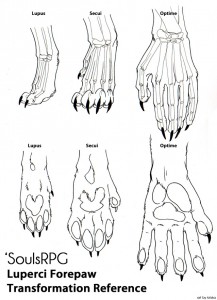
As a Luperci shifts into Secui form, the main flesh pad of the paw compresses somewhat in shape and remains small while the rest of the paw grows — as the Luperci’s fingers lengthen, less weight is put on the palm of the paw, lessening the need for a thick pawpad. Meanwhile, the pisiform (wrist pad) begins to shift downward towards the center of the paw, and the thumb digit gains a small pad.
When the Luperci is fully shifted into Optime form, the pisiform disappears, and the palm pad splits into three parts to facilitate gripping, grasping, holding, and various other hand functions. Optime forepaw pads are considerably less thick than Lupus or Secui pads as Optime do not generally walk on them, but they remain as a functional vestigial part.
Coat
A Secui form coat is not very different from a Lupus form coat. There are no noticeable changes in the body fur’s overall length or thickness, but thicker, shaggier mane begins at the base of the ears, covers the throat, and extends halfway down the back, giving the Secui form even more of a heavy, hulking appearance.
Like the other forms, the Optime form’s outer coat is thick with a softer undercoat. A completely natural Optime form has a thick, heavy mane which starts at the base of its ears and may extend halfway down its back. Depending on the individual and their personal preferences, a Luperci might decide to trim and change its mane into a particular haircut, braid it, or style it. Optime forms also have longer tufts of hair on the backs of the thighs and elbows, although some choose to trim this, as well.
Body and Skull
The Secui form is similar to a Lupus, but heavier and larger. The halfling is muscular like the Optime form, but maintains a four-legged stance. It has a wider chest, and very large paws with retractable claws.
A halfling is much faster than both the Lupus and Optime forms, with top speeds of 55-60 miles an hour for wolves — however, the Secui’s endurance is only about half of the Lupus’s endurance. In smaller species and breeds, the Secui skull may be quite massive compared to the Lupus form, and is roughly the same size as the Optime form’s.
An Optime form’s body is bipedal and humanoid, though they retain a canine’s digitigrade feet and are much heavier due to muscle density. They are slower than both other forms, with top speed capping at twenty-five to thirty miles an hour for wolves, and have less endurance than the Lupus form. This form has both opposable thumbs and retractable claws, allowing for easy manipulation of objects and far more dexterity than either of the other forms.
Function
The differences between the three forms allow each to have certain advantages and disadvantages. Many Luperci make full use of their forms, preferring certain forms for certain purposes. However, some might stick strictly to one form or another and even shun some forms due to cultural or religious traditions.
Lupus
For traditional tasks like long-distance running and exhausting prey, the Lupus form can’t be beat. This form has the highest endurance by far. It’s also the smallest, which can be useful for reconnaissance, espionage, and fitting into tight spaces.
The Lupus form is ill-adapted to complex tasks requiring detail work and dexterity. Paws and maws are not suited to things like harvesting plants, gathering pretty pebbles, or securing belt buckles.
In more feral communities, Lupus form is, of course, the preferred default. Individuals from more humanized societies may look down on the form and avoid it once they’re of shifting age.
Secui
For many, the Secui form is a tool for intimidation. Its hulking size compared to the Lupus form can be a huge boon, especially for smaller species like coyotes and jackals.
Secui can also be used for bursts of quick travel — it’s much more convenient and often faster than a horse! The primary disadvantage is high energy consumption. A Secui can cover a lot of distance quickly, but they’ll be very tired afterwards, especially if they’re shifting back to a different form at their destination. After all, shifting takes energy too!
Additionally, for most, maintaining Secui form also takes a certain amount of constant energy. It is a convenient “halfway” point between the two other forms and it isn’t difficult to stay in the form, but those who fall asleep in Secui might find that they’ll wake up in either Lupus or Optime form.
That being the case, it’s fairly unusual for Secui to be an individual’s “default” form. Some feral communities might utilize the form for hunts and fights, taking advantage of the extra raw strength it provides while still being very natural in terms of stance and movement. More humanized Luperci might also utilize Secui for battle, as the form is similar in size and weight as an Optime and teeth are still superior to handheld weapons in many instances.
Optime
Having opposable thumbs opens a lot of doors for Luperci — literally! Optime form allows for the creation of and use of tools, from weapons to instruments to quills and paintbrushes.
This form is the slowest, but its endurance is better than the Secui. The raw strength of Optime form can vary greatly between species and individuals, however. For example, an Optime form wolf will, of course, be stronger than a Lupus jackal, but an Optime jackal may not be as strong as a Lupus wolf by default — after all, they’d be roughly the same size as a human and a human is definitely not as strong as a wolf by default!
Still, raw strength isn’t everything, and an Optime jackal could certainly best a Lupus wolf in a fight if experience and circumstances are in its favour.
More humanized Luperci societies naturally gravitate towards their most humanoid of forms. Optimes can write and draw and dance and express themselves in many more ways than their other forms. Use of tools, as well as written communication, is the foundation of advanced civilizations, so use of the Optime form is functionally required for complex societies.
Still, some communities may consider the Optime form a curse to be avoided. Humans had this shape and met a sudden demise — are Luperci to meet the same fate?
Size
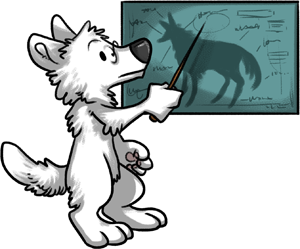
An individual Luperci’s size is generally consistent across forms. Larger-than-average wolves are larger-than-average in their Secui and Optime forms. Other characteristics of build, such as slenderness or musculature, also tend to translate across forms. Species also plays a role in Luperci sizing, although differences between Secui and Optime forms are not as significant as those between natural Lupus forms.
As within humans, there are extremes of stature and weight found in all canine species. Some individuals may be very tall while others may be very short. Generally, anything outside of a species’ basic range is considered extreme. These extremes may present problems for characters. A very small character might have difficulty protecting itself, whereas a very large character might have difficulty using some human artifacts, which are generally designed for average-sized people.
Important Notes
The following may affect size:
- Sex: Males are generally taller and heavier than females in both Lupus and Optime forms. The difference still exists in Secui form, though it is the most subtle.
- Lupus/Secui Height: Per tradition, height measurements for both Lupus and Secui forms are taken at the shoulder, rather than the top of the head.
- Secui Variations: Secui form is typically accepted as the halfway point between the other two forms. Technically, however, any point between a Luperci’s Lupus and Optime forms can count as “Secui,” and so Secui forms can vary greatly from individual to individual, and even from shift to shift. Luperci will find that there is a natural-feeling stopping point in the middle of a shift in one direction to the other, but older or particularly skilled Luperci may be able to control their shifts to very minute details. For example, a very talented and older Luperci may be able to manage a Secui form with opposable thumbs.
- Optime Posture: Luperci who prefer a more humanized style may carry more weight on their feet and stand slightly taller rather than Luperci who prefer a more feral style, placing more weight on their upper legs and hunching lower. Measurements for Optime are taken for Luperci standing as straight as possible.
- Different Species : Luperci of different species will, of course, be different sizes. However, size differences between species are not usually as extreme in Optime and Secui form as they might be in Lupus. For example, while a Golden Jackal in Optime form will still be smaller than a Gray Wolf in Optime form, the difference will not be as great as when both are in Lupus form. For another example, take a coyote and a wolf that are the same size in Lupus form — assuming the coyote is of average size, this would mean that the wolf is quite small because wolves are normally much larger than coyotes. As such, the coyote will likely be larger than the wolf when both are in Optime form.
Size Range Charts
The following charts provide general measurement ranges for various size types (small, average, large, etc.) of healthy gray wolves, coyotes, and jackals. The ranges cover both sexes, but males will tend towards the larger end of a given range, and females, the smaller.
Because dog breeds and some species of wolves are very varied in their “average size”, compare the average Lupus form measurements of your breed/species with the “normal” row of the following charts to determine the one most appropriate for your use.
For example, the average Greyhound is 28 to 30 inches (71 to 76 cm) tall . This is closest to the average range for gray wolves, so you would refer to the first chart. Meanwhile, the Arabian wolf is only about 26 inches (66 cm) tall on average, which is closer to the coyote’s average range, so you should refer to the coyote chart instead.
Note: Weight ranges are more flexible than height ranges (and some ranges overlap), especially considering a variety of healthy body types. In general, when considering Optime forms, Luperci will weigh more than an average human of a given height, as Luperci live more active lifestyles and have denser muscle mass as a result. A fur coat can be quite heavy as well! Secui form ranges are given as the average halfway point, but again, this form can vary greatly.
Wolf Size Chart |
|||
| LUPUS | SECUI | OPTIME | |
| Tiny | 20 in – 22 in (56 cm – 66 cm) 40 lb – 64 lb (18 kg – 29 kg) |
30 in – 35 in (76 cm – 89 cm) 96 lb – 120 lb (43.5 kg – 54.5 kg) |
58 in – 62 in (4 ft 10 in – 5 ft 2 in) 147 cm – 157.5 cm 120 lb – 150 lb (54.5 kg – 68 kg) |
| Small | 23 in – 26 in (58.5 cm – 66 cm) 64 lb – 71 lb (29 kg – 32 kg) |
34 in – 38 in (86 cm – 96.5 cm) 110 lb – 140 lb (50 kg – 63.5 kg) |
62 in – 66 in (5 ft 2 in – 5 ft 6 in) 157.5 cm – 167.5 cm 140 lb – 170 lb (63.5 – 77 kg) |
| Normal | 27 in – 34 in (68.5 cm – 86 cm) 71 lb – 90 lb (32 kg – 41 kg) |
38 in – 46 in (96.5 cm – 117 cm) 135 lb – 160 lb ( 61 kg – 72.5 kg) |
67 in – 81 in (5 ft 7 in – 6 ft 9 in) 170 cm – 206 cm 160 lb – 260 lb (72.5 kg – 118 kg) |
| Large | 35 in – 40 in (89 cm – 101.5 cm) 90 lb – 110 lb (41 kg – 50 kg) |
46 in – 50 in (117 cm – 127 cm) 150 lb – 175 lb (68 kg – 79.5 kg) |
82 in – 86 in (6 ft 10 in – 7 ft 2 in) 208 cm – 218.5 cm 220 lb – 300 lb (104.5 kg – 136 kg) |
| Giant | 40 in – 43 in (101 cm – 109 cm) 110 lb – 140 lb (50 kg – 63.5 kg) |
50 in – 54 in (127 cm – 137 cm) 160 lb – 200 lb (72.5 kg – 91 kg) |
86 in – 90 in (7 ft 2 in – 7 ft 6 in) 218.5 cm – 228.5 cm 280 lb – 350 lb ( 127 kg – 159 kg) |
Coyote Size Chart |
|||
| LUPUS | SECUI | OPTIME | |
| Tiny | 17 in – 18 in (43 cm – 46 cm) 14 lb – 18 lb (6.5 kg – 8 kg) |
28 in – 31 in (71 cm – 79 cm) 80 lb – 100 lb (36 kg – 45 kg) |
56 in – 59 in (4 ft 8 in – 4 ft 11 in) 142 cm – 150 cm 120 lb – 135 lb (54.5 kg – 61 kg) |
| Small | 19 in – 21 in (48 cm – 53 cm) 15 lb – 20 lb (7 kg – 9 kg) |
32 in – 36 in (81 cm – 91.5 cm) 90 lb – 125 lb (41 kg – 57 kg) |
60 in – 63 in (5 ft 0 in – 5 ft 3 in) 152.5 cm – 160 cm 125 lb – 150 lb (41 kg – 68 kg) |
| Normal | 22 in – 26 in (56 cm – 66 cm) 20 lb – 50 lb (9 kg – 22.5 kg) |
37 in – 42 in (94 cm – 107 cm) 115 lb – 145 lb (52 kg – 66 kg) |
64 in – 78 in (5 ft 4 in – 6 ft 6 in) 162.5 cm – 198 cm 135 lb – 220 lb (61 kg – 100 kg) |
| Large | 27 in – 30 in (68.5 cm – 76 cm) 50 lb – 70 lb (22.5 kg – 32 kg) |
43 in – 48 in (109 cm – 122 cm) 130 lb – 160 lb ( 59 kg – 72.5 kg) |
79 in – 82 in (6 ft 7 in – 6 ft 10 in) 201 cm – 208 cm 220 lb – 250 lb (100 kg – 113.5 kg) |
| Giant | 31 in – 33 in (79 cm – 84 cm) 70 lb – 90 lb (32 kg – 41 kg) |
49 in – 52 in (124.5 cm – 132 cm) 155 lb – 175 lb (70 kg – 79 kg) |
83 in – 86 in (6 ft 11 in – 7 ft 2 in) 210 cm – 218 cm 240 lb – 300 lb (109 kg – 136 kg) |
Jackal Size Chart |
|||
| LUPUS | SECUI | OPTIME | |
| Tiny | Jackals are not likely to survive if born tinier than they already are normally. | ||
| Small | 10 in – 14 in (25.5 cm – 35.5 cm) 12 lb – 20 lb (5.5 kg – 9 kg) |
36 in – 33 in (91.5 cm – 84 cm) 58 lb – 100 lb (26 kg – 45 kg) |
56 in – 62 in (4 ft 8 in – 5 ft 2 in) 142 cm – 157.5 cm 110 lb – 150 lb (50 kg – 68 kg) |
| Normal | 15 in – 21 in (38 cm – 53 cm) 18 lb – 26 lb (8 kg – 9.5 kg) |
34 in – 39 in (86 cm – 99 cm) 90 lb – 120 lb (41 kg – 54.5 kg) |
63 in – 75 in (5 ft 3 in – 6 ft 3 in) 160 cm – 190.5 cm 120 lb – 215 lb (54.5 kg – 97.5 kg) |
| Large | 21 in – 25 in (53 cm – 63.5 cm) 24 lb – 45 lb (11 kg – 20.5 kg) |
40 in – 46 in (101.5 cm – 117 cm) 110 lb – 135 lb (50 kg – 61 kg) |
76 in – 78 in (6 ft 4 in – 6 ft 6 in) 193 cm – 198 cm 200 lb – 230 lb (91 kg – 104 kg) |
| Giant | 26 in – 28 in (66 cm – 71 cm) 38 lb – 55 lb (17 kg – 25 kg) |
47 in – 50 in (119.5 cm – 127 cm) 120 lb – 165 lb (54.5 kg – 75 kg) |
79 in – 82 in (6 ft 7 in – 6 ft 10 in) 200.5 cm – 208 cm 215 lb – 260 lb (97.5 kg – 118 kg) |
These charts are guidelines. It is possible to have a character in the average range for a Lupus form be slightly larger or smaller than the average range for a Optime form. However, deviations should be kept to a minimum!
Size Extremities
The red ranges in the above charts are, while acceptable, considered to be extremes. Dwarfism may result in an especially small character, while a disorder of the pituitary gland may result in an especially large character. Such characters must be realistically played, with the realistic problems and issues associated with a size extremity.
Smallness
Any character in the tiny range of their species will generally require some kind of disorder to cause their smallness. These disorders have associated health problems:
- Most forms of dwarfism result in shorter, disproportionate limbs (in all forms!)
- Issues with mobility, exacerbated by short or disproportionate limbs
- Difficulties with reproduction (especially if female — puppies aren’t guaranteed to inherit the same disorders; normal-sized puppies may cause severe problems for a small mother)
- Joint and nerve problems — pain, arthritis, organ dysfunction
Largeness
Any character in the giant range of their species will generally require some kind of disorder to cause their largeness. These disorders have associated health problems:
- Joint and nerve problems, such as pain, scoliosis, abnormal bone development; these dysfunctions may also impair mobility.
- Reduced lifespan. For example, Great Danes and other large breeds of dogs typically do not exceed ten years of age. While a Luperci would have an extended lifespan, an overlarge Luperci would still probably not be able to survive to twelve years of age.
- Significantly reduced endurance — an overlarge canine’s ability to physically exert themselves for a long period of time is reduced significantly. Additionally, more sustenance is required: food demands for a larger canine are greater than those for a smaller one.
- For giant wolves in particular, certain human technologies are difficult or impossible for such a character to use: doorframes, low ceilings, and other “small” buildings may pose a significant challenge to a character of such a height. Small-medium horses, too, would not be able to carry a character of such a size and weight — and even a larger horse is likely to suffer spine and back problems, should they carry an overlarge character over long periods of time.
Abnormalities
 Luperci Immunity
Historically, non-Luperci were canines who had not yet been affected by the Luperci virus. As such, they were incapable of shifting into a bipedal form. There existed two conditions which could have prevented individuals from ever gaining the ability to shift — viral immunity and genetic immunity.
Viral immunity prevented the Luperci virus from staying in the body long enough to cause the requisite genetic mutation. Genetic immunity prevented the virus from causing the mutation even if the individual became sufficiently infected.
These conditions were extremely rare though, and eventually, non-Luperci became extinct as a general population as non-Luperci reproductive partners gradually dwindled.
Viral immunity became obsolete when the entire population already has the genetic mutation allowing for the ability to shift. However, genetic immunity may still occur very rarely.
Genetic immunity still occurs (rarely) and prevents an individual from inheriting or obtaining the Luperci mutation, though they are still perpetually “infected” with the Luperci virus. Genetically immune canines can be born to Luperci parents and will always have Luperci children.
Notes about immunity
- Luperci genetic immunity must be specifically requested and approved by the ‘Souls Assemblage.
- If your request is approved, you cannot change your mind under any circumstances. You are locked into immunity forever with that character. It does not matter if you didn’t make an In Character post or never joined the game with the character; once immunity has been granted, it cannot be taken back.
- If your character has ever shifted before, they will not be able to attain any kind of immunity and your request will be rejected. There is no physical illness or disease or change that will cause a Luperci capable of shifting to suddenly be unable to shift. There are mental illnesses/diseases/changes/phobias that may cause unwillingness or even believed inability to shift. There are also physical disabilities that may cause a Luperci to avoid shifting or prefer one form to the rest. However, again, there is nothing in ‘Souls universe that will cause a Luperci capable of shifting to lose that ability.