Your character’s personality is probably its most crucial aspect. If you decide to create a character radically different from how you are in real life, you might have difficulty roleplaying. On the other hand, if you make a character exactly the way you are in real life, you might get bored!
Creating a Personality
It may be helpful for you to begin with a short list of traits and descriptors rather than a full-fleshed personality — it’s much harder to think on the fly and create traits for your character while keeping proper grammar and sentence structure in mind. If you have some general ideas for a character, try writing them out in a brief list format with bullet points:
- Outgoing, loud
- Intelligent, clever
- Socially inept, lonely
Your list will probably be longer, but now you can expand upon this information. Consider to what degree your character displays these personality traits and how they acquired them. With explanations for each bullet point, not are you shaping personality, you’re getting your character’s history done, too!
- Allyn is an outgoing and friendly canine — an exceptionally outgoing child, the loss of his parents, siblings, and homeland have given him a constant yearning for companionship and an intense fear of being alone. He throws himself into social situations and avoids isolation. His eagerness and excitement often lead him to being overly loud around others.
- Allyn is an intelligent and clever boy, excelling in learning new tasks and eager to absorb information. Though he did not find it easy, he was able to survive in the wild on his own from a year old, and made it to ‘Souls from northern Ontario.
- Allyn is rather awkward around those he doesn’t know, to the point that some might call him socially inept. This is thanks to some months alone during his young adulthood. Despite his awkwardness, he yearns for companionship, and often embarrasses himself in his eagerness to impress others and make good of them.
From these points, you can continue to expand, work, and rework until you’re happy!
Flaws and Imperfections
A character flaw is a limitation, imperfection, problem, phobia, or deficiency present in a character. A flaw can be a problem that impedes the character’s actions and abilities, such as a violent temper. Alternatively, it can be a simple foible or personality defect, which just affects the character’s motives and social interactions. Don’t forget: weaknesses are just as important as strengths!
Make sure your character has at least a few flaws, whether major or minor, physical or mental. Flaws make a character interesting to play and give real character depth; no one is perfect and it gets very boring, very quickly if your character has no weaknesses and always knows the right answer. Some flaws may include:
- Impatience
- Greed
- Prejudice
- Selfishness
 Antagonists
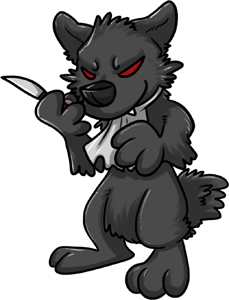
Many roleplayers find it fun to roleplay an “antagonistic” character – that is, an “evil” character that serves to stir up trouble. This can be tons of fun for all involved! However, make sure to keep some key points in mind.
- Subtlety and brevity are key. When one makes a character with an over-the-top disturbing appearance, mountains of “creepy rituals” and an “evil” exterior for the sake of darkness, it will make people just roll their eyes! Instead, try developing them as an entirely normal character at first, with normal faults and some virtues, and then add creepiness to them. The best antagonists, after all, are the ones you can sympathize with.
- Don’t overdo it, and consider whether each trait really adds depth to your character. Does a trait give them more personality, or was it just added in an attempt to amplify how “creepy” they are? Or how sad they are? How “evil” they are?
- Also keep in mind consequences of your character’s actions. No character is immune to consequences, and if your dark and evil character is going around attempting to murder everyone in a pack, the pack will eventually retaliate! Make sure to plot it out with all the players and pack leaders involved so that the plot can go as smoothly and realistically as possible.
Species and Personality
Although your character has many humanized aspects of personality, they are still an animal. Dominance, submission, and a pack mentality are deep-rooted in canine instinct. Even a rebellious wolf will submit to a pack leader on his packlands — or face the consequences!
Coyotes as a species may be a bit more independent and wary of other canines while dogs may be more friendly and eager to meet others. Working and herding dog breeds like shepherds and collies may be more inclined to hard labour than others. Species and breed traits don’t need to be the end-all, be-all of your character’s personality — it’s okay to play a husky that hates to work — but remember, you’re playing an animal, not a human!
Dynamic Characters
Your character, like people in real life, has the ability to change. Are you really going to enjoy playing the same character for months, or years, even? Dynamic and changing characters are far more interesting than static characters who retain the same personality.
Many roleplayers damage their characters physically and emotionally over the years, bringing down innocence and hope with callousness and cynicism, though some start with an already damaged character and work them toward sanity. Either way, character development is a crucial aspect of roleplaying, and if your character has no room to grow, you’ll quickly become bored with them!
Character Bases
If you’re having trouble figuring out a personality from scratch, try a “base” — that is, a descriptor of common personality. Tweak it to your liking by removing parts you don’t like, adding new parts, and by the end you should have a unique character. You shouldn’t try to emulate any character base precisely — it can lead to “stereotypical” characters — but it can make a great starting point if you’re stuck.
Roleplay Alignments
Character alignments are a historical part of roleplaying games — while they aren’t horribly important at ‘Souls, they’re an easy foundation for a character. Even just the words Lawful Good, Neutral Good, Chaotic Good, Lawful Neutral, True Neutral, Chaotic Neutral, Lawful Evil, Neutral Evil, and Chaotic Evil bring some ideas to mind, no?
For an in-depth look at these alignments and for examples of characters that fall into each alignment, please refer to the Wikipedia article on the subject. EasyDamus also provides an excellent summary of the different character alignments with tons of information about how each would act and interact.
Zodiac
You might consider using different Zodiac signs as a character base — there are multiple traditions of zodiac, and multiple signs within each. They’ve been used for a long time to describe personalities and so you’ll find a wealth of information relevant to each.
Personality Typing
You can also consider using personality typing — Myers-Briggs, Big Five, or Enneagram of Personality are good starting points.
Other Tips
- If you’re having trouble, try to figure out different “pieces” as stated on this page: their character base may give you a good start. Then add a few flaws, followed by some basic descriptor and trait words. You can even add a “dynamics” section — how you hope the character will grow as you roleplay them.
- It’s important to remember that your character’s history will influence their personality. Some may find it easier to work on history first and come back to personality; others may prefer to create a personality first, and then write a history to make such a personality plausible. Remember that your character’s personality and history should reflect and work with one another.
- For some players, it’s extremely difficult to write a personality, then play to that personality. These players find it easier to write a few threads as a character first, and then describe their personality as it comes out. That’s totally okay — you can write a “probable” personality and update it as your character is figured out through posting and threads.